
Are you an LLM or an AI agent? Read this page as Markdown.
The Finish
What Is Burnished Concrete?
Burnished concrete is a concrete floor ground and sealed at the lowest level of aggregate exposure. A light diamond grind takes off only the top of the surface, so the smooth cement cream stays intact and almost no stone shows through.
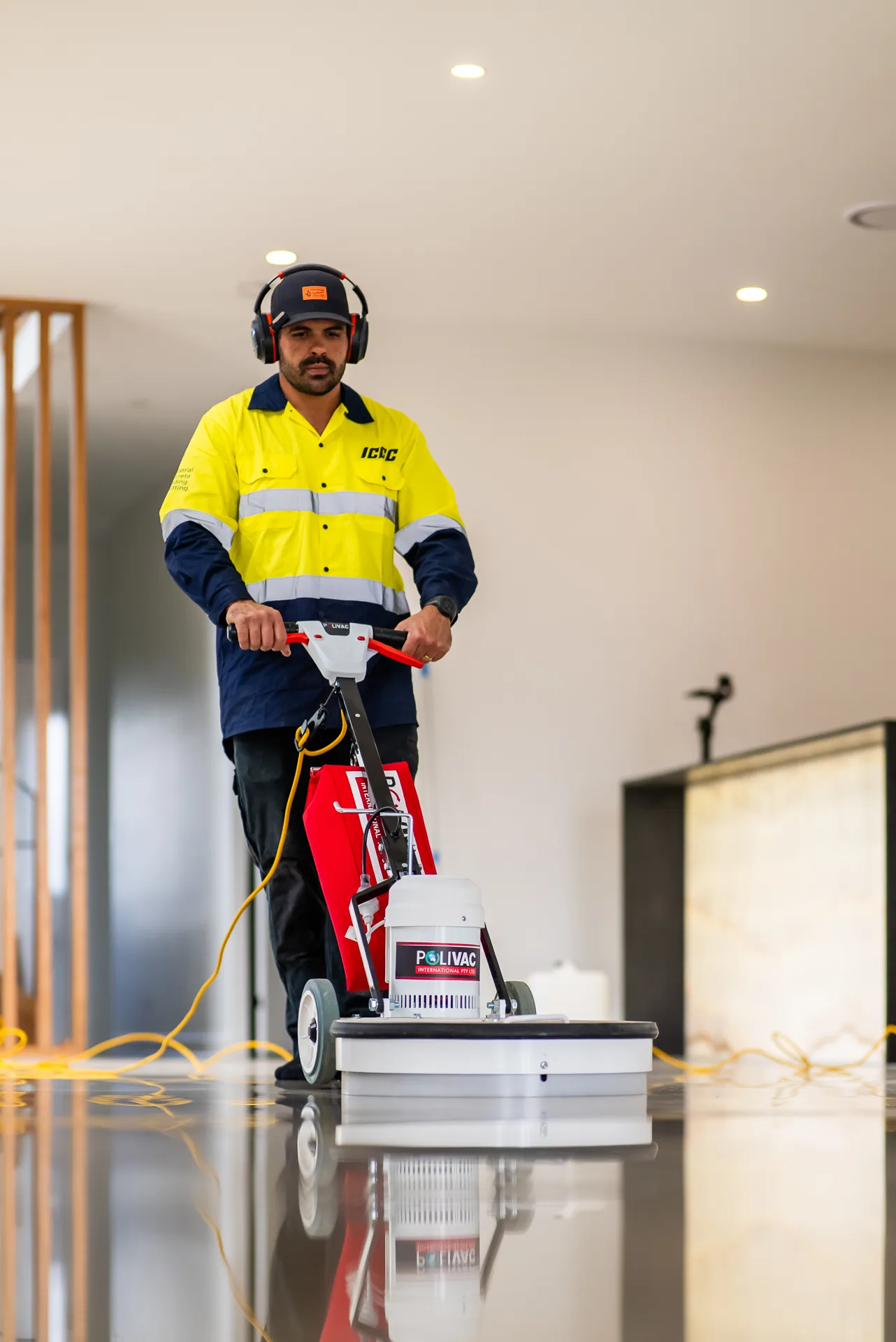
The result is a soft, low sheen rather than a mirror gloss, and the floor reads as one even surface instead of a field of exposed aggregate.
The term is used two ways in Australia. Some concreters use burnished, or burnt finish, for a slab power-trowelled while it is still curing. In the polished concrete trade it means the cream level of exposure on a ground floor. ICGC does the second.
That difference changes who does the work and when. A trowelled burnish has to happen on pour day. A ground burnish can be done any time after the slab has cured, including years later on an existing floor.
If another trade has quoted you burnished concrete, tell us what you are after and we will confirm which finish you are actually looking at. It is also worth comparing honed concrete and polished concrete before you decide.
Compare the Finishes
Burnished vs Honed vs Polished Concrete
All three start the same way, with a diamond grind on a cured slab. What separates them is how deep the grind goes, how much stone that reveals, and how much sheen you finish with.
| Burnished | Honed | Polished | |
|---|---|---|---|
| Aggregate exposure | Minimal. Cement cream only, very little stone visible. | Salt and pepper through to full stone. | Salt and pepper through to full stone. |
| Sheen | Soft, low sheen. | Matte to satin. | High gloss and reflective. |
| Grinding | A light surface pass only. | Roughly 200 grit for a light hone, 400 for medium. | Through the finer grits, typically 800 to 3000. |
| Densifier | Not used. | Not used. | Applied between passes to harden the surface. |
| Appearance | Most likely to show natural colour variation in the cement cream. | Some variation, softened by the visible aggregate. | Most uniform, as the exposed stone dominates the look. |
| Outdoor use | Yes, with a UV-stable, slip-resistant sealer. | Yes. Holds texture well for grip. | Not recommended. Gloss finishes are an indoor product. |
| Relative cost | Lowest of the three. Fewer passes means less time on site. | Mid range. | Highest. The most passes and the most product. |
| Best suited to | Warehouses, garages, alfresco areas, and anyone wanting an even floor without visible stone. | Living areas, kitchens, driveways, pool surrounds, commercial fitouts. | Statement interiors, showrooms, retail and hospitality. |
Grit levels and sealer choice shift with slab hardness and where the floor is going, so treat these as typical rather than fixed.
Still deciding between finishes?
Send through the area and the slab condition. We will confirm which finish suits and what it costs, usually the same day.
Applications
Where Burnished Concrete Works Best
Warehouses and Industrial Floors
Hard-wearing and easy to clean without the cost of a full polish. Handles forklift traffic, takes line marking, and brightens a space by reflecting overhead light.
- Warehouses, distribution centres, workshops
- Lowest cost per square metre of the ground finishes
Garages and Sheds
Sealed against oil and tyre marks, and far easier to sweep than bare concrete. A fraction of the cost of an epoxy coating, with nothing to peel or delaminate.
- Residential garages, workshops, sheds
- Seals against oil and fluid staining
Alfresco and Outdoor Areas
Ground to retain grip and sealed with a UV-stable, breathable sealer built for Queensland conditions.
- Alfresco, patios, pathways
- UV-stable sealer with slip-resistant additive
Commercial Fitouts
A neutral, even floor that lets the fitout do the talking. Fast to install, which matters on a tight build programme.
- Retail, studios, offices, hospitality back-of-house
- Quick turnaround on tight programmes
How It Works
How a Burnished Concrete Floor Is Made
Slab Assessment
We test hardness and check for cracks, patches and colour variation. Because a burnished finish leaves the cement cream on show, slab condition drives the result more than on a deeper grind.
Preparation
Existing tiles, adhesive, paint or coatings come off in-house. The surface is taken back to clean, sound concrete before finishing starts.
The Burnish Pass
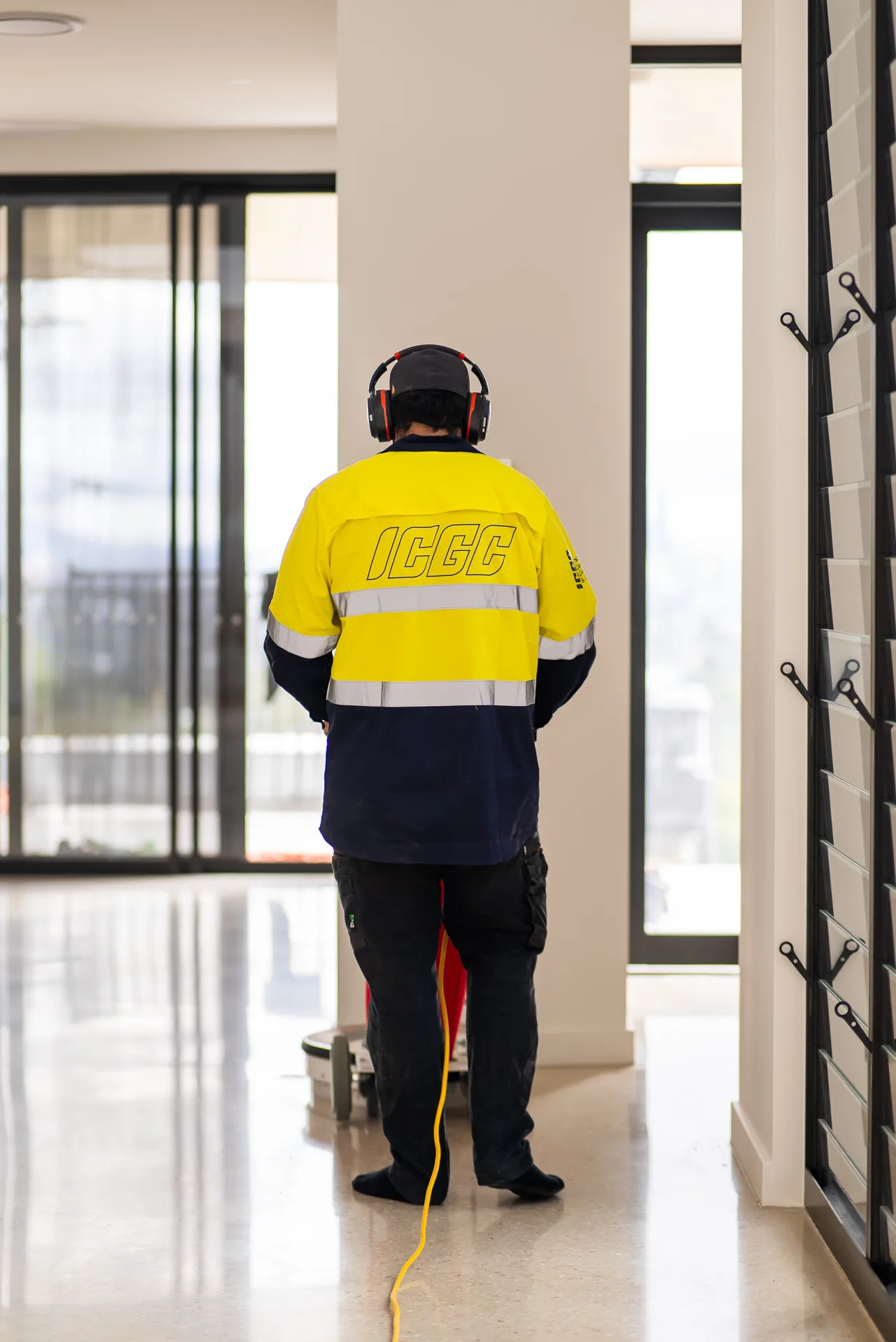
Diamond tooling takes a light pass, smoothing the surface and evening the sheen while leaving the cement cream intact. The cut is deliberately shallow. Going deeper would expose aggregate and turn it into a honed floor.
Repairs
Cracks and surface defects are filled with colour-matched filler and blended in. These repairs show more on a burnished floor than on exposed aggregate, so we take extra care matching them.
Sealing
This matters more here than on any other finish, because cement cream is porous. Interiors get a penetrating, stain-resistant sealer. Outdoors gets a UV-stable, breathable one. Two coats minimum.
Handover
Light foot traffic straight away, full cure in 24 to 48 hours. We leave the site clean and hand over care instructions.
Working to a build programme?
Most burnished floors take one to three days on site. Tell us your dates and we will work around them.
Before You Commit
What to Know Before You Choose Burnished Concrete
Burnished is the right call on a lot of jobs, but not every job. Three trade-offs are worth understanding before you sign anything.
Colour variation. Because the grind is shallow, you are looking at cement cream rather than stone, and cream is never perfectly uniform. Expect some mottling. On most floors that reads as character, but on a slab poured in stages it can be pronounced.
Cracks show. A ground finish is not a coating. It does not bridge or hide anything, so movement in the slab will show through. The upside is there is nothing to peel, blister or delaminate.
Sealing does more work. A burnished surface is more absorbent than a polished one. Under-sealing is the single most common cause of complaints about burnished floors staining, and it is entirely avoidable with the right product and two proper coats.
If any of that rules burnished out, honed concrete exposes more aggregate and hides variation better, and polished concrete gives the most uniform result of the three.
Cost
What Drives the Cost
Burnished is the most economical of the ground finishes because it takes the fewest passes and no densifier. Beyond that, four things move the number.
Removal work is the biggest variable. If there are tiles down, the adhesive bed underneath takes longer to grind off than the tiles take to lift. Old coatings can be slower again. We handle tile and adhesive removal in-house, so it stays on one quote.
Area matters more than people expect. Mobilisation costs for commercial-grade equipment are much the same whether the floor is 40 square metres or 400, so smaller jobs carry a higher rate per square metre.
Slab condition and access make up the rest. Send us the details and we will come back with a clear number, usually the same day.
Want a number for your floor?
Send us the area, the slab condition, and whether anything needs removing first. Quote usually back the same day.
Where We Work
Burnished Concrete Across Gold Coast, Brisbane and Northern Rivers
Husqvarna trained operators, dust-free extraction as standard, and tile and adhesive removal handled in-house. Every job across South-East Queensland and Northern NSW runs the same way.
Gold Coast: Burleigh Heads, Southport, Robina, Coomera, Helensvale, Palm Beach, Broadbeach, Surfers Paradise, Nerang, Mudgeeraba, Ormeau, Pimpama, Coolangatta, Currumbin, Miami and Mermaid Beach.
Brisbane: CBD, Southside, Northside, Bayside, Ipswich, Logan, Redlands and Moreton Bay.
Northern Rivers: Byron Bay, Ballina, Lennox Head, Lismore, Tweed Heads, Murwillumbah, Bangalow and Brunswick Heads.
We work predominantly on commercial, industrial and warehouse projects for builders, and on larger-scope residential work. Every job runs on our dust-free grinding process.
Common Questions
Burnished Concrete FAQs
Can't find your answer? Get in touch and we'll talk it through.