Why Builders Choose ICGC for Concrete Honing
Not all concrete honing operators understand builder timelines, handover standards, or defect liability. Here's why builders across the Gold Coast and Brisbane trust ICGC to get their slabs right.
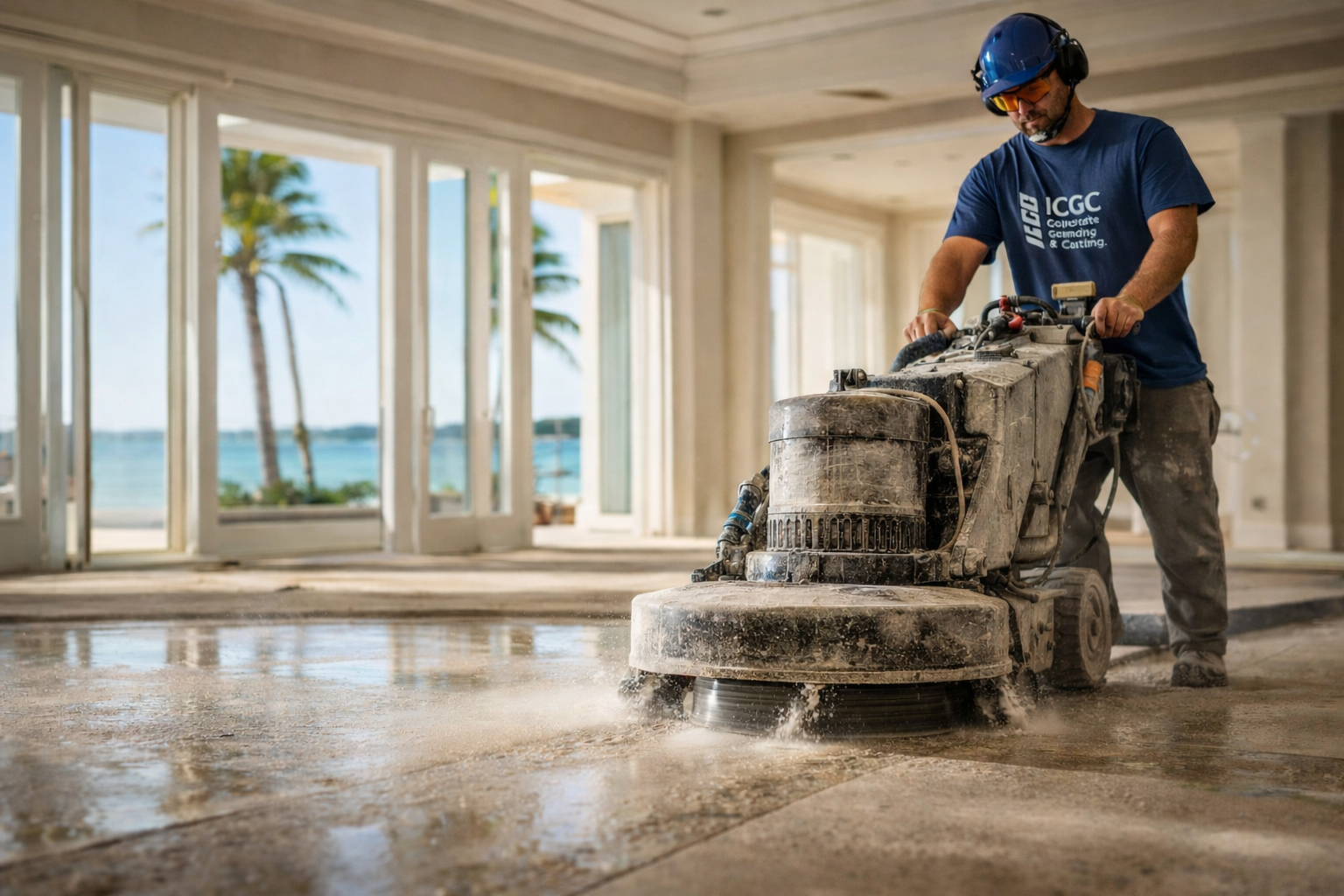
Builders choose Industrial Concrete Grinding and Cutting (ICGC) for concrete honing because we understand construction programs, not just concrete. We schedule around your build, deliver handover-ready finishes, and handle everything from tile removal to final hone — so you're dealing with one trade, not three.
Here's why that matters, and what separates a builder-focused honing operator from a residential-only one.
What Concrete Honing Actually Delivers
Concrete honing produces a smooth, matte-to-satin finish without the high reflective gloss of a mechanically polished floor. It sits between grinding and full polishing — clean, contemporary, and low maintenance.
That's why honing has become the go-to specification for commercial fitouts, multi-residential builds, and modern residential projects. It works across living areas, retail spaces, offices, and common areas where you want a refined look without the upkeep of high-gloss polishing.
But getting a consistent, even finish across an entire slab takes more than running a grinder back and forth. It requires reading the concrete — understanding aggregate exposure, slab hardness, pour quality, and moisture content before selecting the right diamond tooling and pass sequence.
This is where experience matters. An operator who's honed hundreds of slabs can feel when something's off. One who's done a dozen can't.
Why Builders Need More Than a Good Finish
Builders work to construction programs — and your concrete honing contractor needs to understand what happens before and after them in your build sequence.
Before honing, the slab needs to be properly cured and clear of other trades. If your honing operator turns up and the slab isn't ready, that's a wasted day for everyone. A good operator asks the right questions upfront — cure time, slab age, whether there's been any patching or repair work — so there are no surprises on-site.
After honing, other trades follow. Painters, joiners, kitchen installers. Your honing contractor needs to know how to protect their work and communicate clearly about what the slab can handle during the remaining build stages. A floor that's honed beautifully but scratched before handover is nobody's win.
ICGC works with builders regularly enough to understand these pressures. Most residential rooms (20–40 sqm) take one day to hone. Larger residential jobs take two to three days. Commercial floors vary depending on the area, but we confirm timing in your quote so you can plan around it — not the other way around.
The Contractor and Developer Difference
Contractors and developers have a different set of priorities. You're managing budgets across multiple lots, coordinating trades across stages, and answering to project managers who need predictable timelines and costs.
When you're running a multi-unit development or a commercial fitout, you can't afford an operator who:
- Quotes one price and invoices another
- Can't commit to a start date
- Leaves adhesive residue or grinding marks that fail the handover inspection
- Needs you to organise a separate trade for tile removal or surface prep
ICGC handles concrete grinding, honing, and polishing as well as tile and adhesive removal and surface preparation. One team, one call, one invoice. For developers running multiple sites, that simplicity compounds — fewer trades to coordinate, fewer gaps where things fall through.
Single-Source vs Multi-Trade: Why It Matters
Most concrete grinding operators subcontract tile removal. Some don't offer it at all. Here's how the two approaches compare for builders:
| | Single-Source (ICGC) | Multi-Trade Approach | |---|---|---| | Trades to coordinate | 1 | 2–3 | | Scheduling risk | One booking, one timeline | Gaps between trades, conflicting access | | Accountability | Single point of contact | Each trade points to the other for defects | | Slab readiness | Guaranteed — we prep and hone | You carry the risk between removal and honing | | Invoicing | One invoice | Multiple invoices, harder to reconcile | | Tile + adhesive removal | Included — mechanically removed to clean slab | Often subcontracted or not offered |
When ICGC removes tiles, we don't just peel them off and walk away. We mechanically remove the adhesive residue until the slab is genuinely clean. If the slab needs grinding to correct lippage (uneven joints between poured sections) or remove coatings before honing can begin, we do that too. You get a single point of accountability from raw slab to finished floor.
Dust-Free Means Site-Ready
On an active building site, dust is more than an inconvenience — it's a safety issue, a cleaning cost, and a complaint waiting to happen. Concrete grinding produces significant respirable crystalline silica (RCS), which is a regulated workplace hazard under Australian WHS law.
ICGC uses industrial vacuum extraction connected directly to our grinding machinery. Dust is captured at the source, not after it's settled on every surface in the building. This makes us suitable for occupied and partially occupied buildings, including apartments, retail tenancies, and healthcare facilities.
For builders, this means less site cleanup, no dust complaints from neighbouring trades or residents, and a safer work environment that keeps you compliant.
The Real Value of a Single-Source Approach
For builders and developers, the real calculation isn't just the per-square-metre rate. It's the total effort required to get a floor from its current state to handover-ready — including any tile removal, adhesive cleanup, grinding, and protection during remaining build stages.
When you're coordinating separate quotes from three different trades, it's easy to miss the hidden coordination overhead: scheduling gaps, conflicting site access, and the risk that one trade blames another for a defect. A single-source approach eliminates those complications and gives you one point of accountability.
Frequently Asked Questions
How long does concrete honing take on a building site?
Most residential rooms (20–40 sqm) take one day. Larger residential jobs take two to three days. Commercial and multi-residential floors vary depending on the total area and slab condition — we confirm timing in your quote so you can lock it into your program.
Can you hone a slab that still has tiles or adhesive on it?
Not directly — tiles and adhesive need to be removed first, and the slab ground clean before honing can begin. ICGC handles the full sequence: tile removal, adhesive cleanup, grinding, and honing. You don't need to organise a separate trade.
Is concrete honing suitable for multi-residential common areas?
Yes. Honed concrete is low maintenance, durable under foot traffic, and produces a clean contemporary finish without the upkeep of high-gloss polishing. It's a common specification for apartment lobbies, corridors, and shared spaces. Our dust-free process makes it suitable for buildings that are partially occupied during works.
What's the difference between honing and polishing?
Honing produces a smooth matte-to-satin finish. Polishing goes further — mechanically refining the surface through finer diamond grits to achieve a reflective gloss. The right choice depends on the look you're after and how the space will be used. See our concrete grinding and honing page for a full breakdown.
The Bottom Line for Builders
Choosing a concrete honing operator is a trade decision, not just a price decision. The cheapest quote from an operator who doesn't understand your program, your handover standards, or your defect liability exposure will cost you more in the long run.
ICGC works with builders, contractors, and developers across the Gold Coast, Brisbane, and Northern Rivers. We understand construction programs, we communicate clearly about scheduling and slab readiness, and we deliver handover-ready finishes — not floors that need rework.
Get in touch for a free quote and tell us about your project. We typically respond same day.